Showing posts with label Gardening. Show all posts

Sunday, April 3, 2011

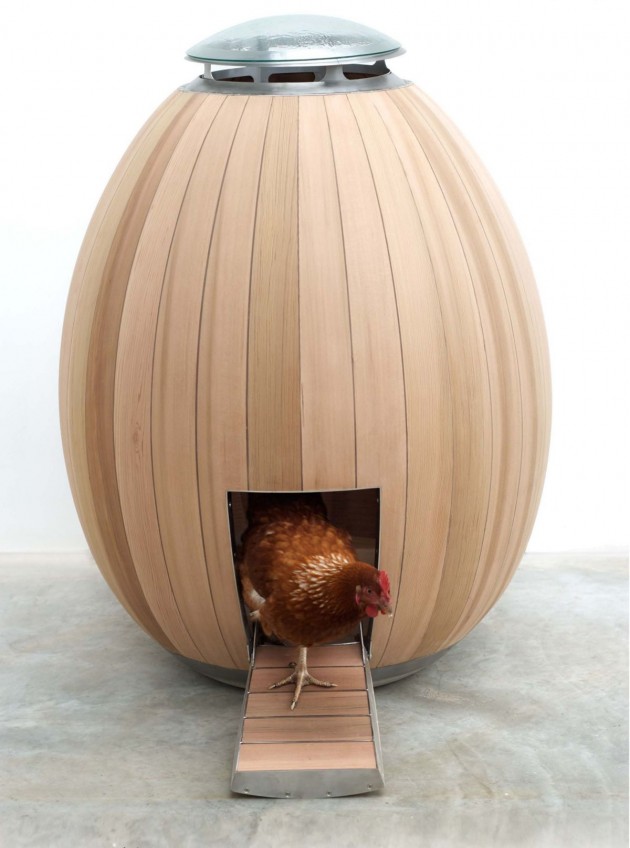
Modern Chicken Coop

After reading Michael Pollan's The Omnivore's Dilemma border= and Barbara Kingsolver's Animal, Vegetable, Miracle border= I started a vegetable garden and I've wanted to start raising chickens for eggs.

Now I want this chicken coop, too:
(via homeedit)

Sunday, October 26, 2008

Fall Garden Update (Square Foot Gardening)


I just realized that it's been two months since I last wrote an update about my fall garden.

I still have not purchased Barbara Ellis's The Veggie Gardener’s Answer Book and I'm still a fan of Mel Bartholomew’s All New Square Foot Gardening (click here to view all my posts on that book).

The fall garden has been as productive as the summer fruit and vegetable garden (with yellow pear and grape tomatoes, full size tomatoes, summer squash plants, eggplant, and more) and I've gotten used to eaten salad from greens freshly harvested, making stir-fry with bok choy or mibuna asian mustard greens straight from the garden, crispy roasted homegrown kale, delicious baby ox heart carrots, spicy hot scarlet globe radishes, and I'm looking forward to lots of winter squash.

I highly recommend Barbara Kingsolver’s Animal, Vegetable, Miracle: A Year of Food Life, Michael Pollan’s The Omnivore’s Dilemma: A Natural History of Four Meals, and Mel Bartholomew’s All New Square Foot Gardening to anyone considering gardening.

Monday, September 29, 2008

Books Mentioned in Michael Pollan's In Defense of Food

Though I didn't feel like Michael Pollan's In Defense of Food: an Eater's Manifesto had much material not found in his other writings and talks (click here to view all my posts about this book), it did give me a very long list of books that I may want to read:
Whew.

Thankfully I've already read these books mentioned by Pollan:

Monday, September 22, 2008

In Defense of Food by Michael Pollan

As promised, here's a bit more on Michael Pollan's In Defense of Food: an Eater's Manifesto (click here to view all my posts about this book).

Most of the contents of this book can be found from other sources by Michael Pollan -- his articles in the New York Times, The Omnivore’s Dilemma, Pollan on C-SPAN, and Pollan on NPR several times.

What's new is mostly his lists to help us decide what to eat (and even this can be learned from Pollan's talk on C-SPAN):

Eat Food
  • Don't eat anything your great grand-mother wouldn't recognize as food: Don't eat anything incapable of rotting.
  • Avoid food products containing ingredients that are a) unfamiliar, b) unpronounceable, c) more than five in number, or that include d) high-fructose corn syrup.
  • Avoid food products that make health claims.
  • Shop the peripheries of the supermarket and stay out of the middle.
  • Get out of the supermarket whenever possible: Shake the hand that feeds you.

Mostly Plants
  • Eat mostly plants, especially leaves: did you know that the average American eats 200 pound of meat per year?
  • You are what what you eat eats too.
  • If you have the space, buy a freezer.
  • Eat like an omnivore.
  • Eat well-grown food from healthy soils: "it stands to reason that a chemically simplified soil would produce chemically simplified plants."
  • Eat wild foods when you can: lamb's quarters and purslane, wild game meat, salmon, mackerel, sardines, and anchovies are good bets.
  • Be the kind of person who takes supplements.
  • Eat more like the French, or the Italians, or the Japanese, or the Indians, or the Greeks.
  • Regard non-traditional foods with skepticism.
  • Don't look for the magic bullet int he traditional diet.
  • Have a glass of wine with dinner.

Not Too Much

  • Pay more, eat less: Okinawan's say hara hachi bu, eat until you are eighty percent full.
  • Eat meals: didn't there used to be at least a mild social taboo against the between meal snack?
  • Do all your eating at a table: your desk is not a table.
  • Don't get your fuel from the same place your car does.
  • Try not to eat alone.
  • Consult your gut.
  • Eat slowly.
  • Cook and, if you can, plant a garden.

Well, that's it. Pretty simple huh? We should all be slimmer and healthier in no time.

There are a couple of other things I found interesting from this book.


First, since Pollan makes several references to Upton Sinclair’s The Jungle, I'm glad that I finally read it. And like Devra Davis in The Secret History of the War on Cancer, Pollan also posits that the health industry (as a business) has had much to gain from the unhealthiness of Americans -- Pollan mentions fast food companies while Davis mentions large industrial companies. It's always interesting to see how books by different authors seem to converge.

And did you know that the average American today spends less than 10% of their income on food and less than thirty minutes each day preparing meals, and about an hour each day enjoying them; in 1965 the average American spent 44 minutes prepping meals and 21 minutes cleaning up. This lack of cooking, Pollan postulates, has something to do with our unhealthiness.

And check out these calories per day contributions to America's per capita food supply:
  • Corn: 554
  • Soy 257
  • Wheat 768
  • Rice 91

That totals 1,670 and these four crops acccount for two thirds of the calories we eat. It makes me sick just thinking about it. According to Pollan, "humankind has historically consumed some 80,000 edible species, and three thousand of those have been in widespread use." And now we eat mostly just four species, just because they are among the most efficient transformers of sunlight and chemical energy into carbohydrate energy??!

And if that wasn't enough:
  • Half of all broccoli grown commercially in the US is the Marathon variety, known for its high yield.
  • Most of the chickens raised for meat in America are Cornish cross hybrid.
  • More than 99% of the turkeys raised for meat in Americaare Broad-Breasted Whites.

A typical Iowa farm in the early 1900s would have "raised more than a dozen different plant and animal species: cattle, chicken, corn, hogs, apples, hay, oats, potatoes, cherries, wheat, plums, grapes, and pears" and now that same farm would produce just corn and soybeans.

All of this lack of complexity has resulted in a substantial decline in the nutritional quality of produce in this country -- and that's as determined by the USDA.

And here's an interesting quote for you:
The increases in world [omega-6] consumption over the past century may be considered a very large uncontrolled experiment that may have contributed to increased societal burdens of aggression, depression, and cardiovascular mortality.

Hmm, maybe Baltimore would be less violent if it's drug-dealing residents ate a lot more omega-3 fatty acids?!
Saturday, September 20, 2008

The Veggie Gardener's Answer Book by Barbara W. Ellis

I just got back from my local grocery store where I found a fantastic resource for fruit and vegetable gardening: The Veggie Gardener's Answer Book: Solutions to Every Problem You'll Ever Face Answers to Every Question You'll Ever Ask by Barbara W. Ellis.

It's a small book - just over 4" x 6" and about 1.25" thick -- but the cover is sturdy and its full of useful tips for organic gardening.

Part 1 of this book applies organic methods to planning and planting a vegetable garden, improving soil, and controlling pests and diseases.

Part 2 is a crop-by-crop guide to starting, growing, and harvesting the most popular vegetables (with some, like brassicas, e.g., cabbages and broccoli, grouped together). Entries begin with a list of tips for success and include answers about general care and harvesting. The "Problem Patrol" section of each entry provides easy answers to fix typical problems through both prevention and treatment.

My favorite part is the table of fruits and veggies that tells you how many plants per person you should plant and whether you should do succession planting.

As much as I like Mel Bartholomew’s All New Square Foot Gardening (click here to view all my posts on that book), I do feel like it leaves many questions unanswered. Got to add The Veggie Gardener's Answer Book to my list of books to purchase.

Saturday, September 13, 2008

Friends' Recommendations

Three friends each recommended a book this week:

The first book is a memoir about producing organic veggies on a small farm in Pennsylvania Dutch country, after giving up his city life in Brooklyn, NY.  Using an old Toyota pickup, he transported his first auspicious crop of Hill Billies, Tiger Toms and Radiator Charlie's Mortgage Lifters to the Union Square Greenmarket and soon began to sell his produce to New York's posh kitchens.

Considering my ongoing interest in gardening, and my enjoyment of books related to organic food, I think I would rather enjoy this book. Though I'm not sure I've got time for it.

Click here to read an excerpt of Heirloom.


One Party Country is by two The Los Angeles Times journalists -- Wallsten covers the White House and national politics and Hamburger is an investigative reporter.

The author's premise is that despite the Bush Administration's current unpopularity, the Republican domination of American politics is unlikely to end anytime soon due to the powerful Republican machine. Thanks to Karl Rove and others, the Republicans have identified and commodified every potential vote in the nation through large-scale fundraising, targeted single-issue marketing, manipulative gerrymandering, and more.

Definitely relevant to this year's presidential election and possibly worth reading, but not sure it'll jump to the top of my list of books to read.

Click here to read an excerpt.


And the last book is about the history of marriage from Adam and Eve to modern times. In irreverent laugh-out-loud-funny prose, Squire argues that marriage was developed to establish paternity by controlling the sex life of women. It received a favorable review from Slate's Dahlia Lithwick in her New York Times book review "I Now Pronounce You Totally Confused" published September 5, 2008.Click here to read an excerpt of I Don't.

I'm always interested in learning about the history of our traditions so I Don't is definitely my kind of book. I'll have to put it on my list to read next year.

Funny that all of these books were featured on NPR -- guess that's what everyone's listening to these days.

Monday, August 25, 2008

Perennial Vegetables by Eric Toensmeier

I want to cultivate taro to eat here in Maryland and need some advice.

Ans great as Mel Bartholomew’s All New Square Foot Gardening is, the fruits and vegetables listed by Bartholomew are pretty run-of-the mill -- no taro or other asian fruits or vegetables!

And while Better Homes and Gardens Step-By-Step Successful Gardening is certainly helpful for learning about gardening basics (fruits, vegetables, flowers, trees, shrubs, vines, you name it!), the content is also pretty standard.

I've been told to get these books to learn about taro cultivation:

Any thoughts?

I already know that people grow taro (otherwise known as kalo and elephant ears) here in Maryland for landscaping purposes, but I want to know whether I can grow it to eat and whether I need to buy a specific variety for eating instead of just landscaping.

Sunday, August 24, 2008

Fall Garden with Square Foot Gardening - Updated

My fall vegetable garden is looking great!

The arugula and radish look about ready to eat; the lettuces, broccoli, cauliflower, cabbage, carrots, kale, and asian greens (Mibuna mustard greens and Prize Choy bok choi) are all coming along quite nicely. And the winter squashes (Burgess Buttercup winter squash, Uchiki Kuri winter squash, and Delicata winter squash) are just beautiful small plants with large leaves that are growing rapidly.

I’ve also just planted the peas along side my tomato plants (I'm hoping to train the vines up my tomato cage) and planted more of the lettuce, arugula, and radishes alongside my broccoli, cauliflower, and cabbage plants -- I'm trying to master companion planting after reading Mel Bartholomew’s All New Square Foot Gardening and Better Homes and Gardens Step-By-Step Successful Gardening.
I've also just updated my fall garden map. Take a look:


What do you think?

Saturday, August 23, 2008

Labyrinths for the Spirit by Jim Buchanan

Do you like labyrinths? Or meditative natural spaces? Then you'll love this book I just flipped through -- Labyrinths for the Spirit: How to create your own labyrinths for meditation and enlightenment by Jim Buchanan.

Here's the product description provided by Gaia Press, the publisher:
"By moving in a focused and directed way through the labyrinth, we begin to relax, and our sixth sense becomes heightened." That's how the author, a renowned labyrinth-maker and "land artist," describes the effect of walking the traditional and contemporary labyrinths explored here. Examples range from classic Greek and medieval designs to patterns used in Native American basketry, as well as the author's distinctive creations, which push the boundaries of the form. Connecting the spiritual aspects of walking the labyrinth to the creative act of construction, the guide offers illustrated instructions for making more than 20 different labyrinths, with suggestions on how to choose the site and the materials that best enhance the symbolic power of the completed work.

Seems like a must-have book if you plan on building large labyrinths of any kind -- it even includes plans on building a medieval Chartres type labyrinth which incorporates complex numerology, having deep significance for its walkers.

I think I've got about all I can handle with my garden, so while I won't be making a labyrinth in my backyard I would love to hear about your plans!

Thursday, August 14, 2008

Diana Beresford-Kroeger

I just read "Advocating an Unusual Role for Trees" about the intriguing and pioneering scientist Diana Beresford-Kroeger (written by Jim Robbins and published on NYTimes.com on August 11, 2008).

I was drawn to this article partly because of my newfound appreciation for trees due to reading Richard Preston's The Wild Trees: A Story of Passion and Daring (click here to read all my posts on that book).

Born in Ireland and currently working at the University of Ottawa school of medicine, Beresford-Kroeger is a botanist, agricultural and medical researcher, lecturer, and self-described "renegade scientist" in the fields of classical botany, medical biochemistry, organic chemistry, and nuclear chemistry.

Here's an excerpt from the NYTimes.com article:
She calls herself a renegade scientist, however, because she tries to bring together aboriginal healing, Western medicine and botany to advocate an unusual role for trees.

She favors what she terms a bioplan, reforesting cities and rural areas with trees according to the medicinal, environmental, nutritional, pesticidal and herbicidal properties she claims for them, which she calls ecofunctions.

...

But some of Ms. Beresford-Kroeger’s claims for the health effects of trees reach far outside the mainstream. Although some compounds found in trees do have medicinal properties and are the subject of research and treatment, she jumps beyond the evidence to say they also affect human health in their natural forms. The black walnut, for example, contains limonene, which is found in citrus fruit and elsewhere and has been shown to have anticancer effects in some studies of laboratory animals. Ms. Beresford-Kroeger has suggested, without evidence, that limonene inhaled in aerosol form by humans will help prevent cancer.

Sounds a little crazy, and definitely lacking hard scientific proof, but it could be true! After all, studies have not been done to study the effects on humans due to natural ambient compounds from trees.

And that Miriam Rothschild, an eccentric home-schooled British naturalist whom I greatly admire, "wrote glowingly of Ms. Beresford-Kroeger’s idea of bioplanning and called it 'one answer to 'Silent Spring'' because it uses natural chemicals rather than synthetic ones" makes me even more interested in Beresford-Kroeger work.

Beresford-Kroeger is also the author of several books, all of which I'd like to take a look at:

I will have to see if my local library carries any of these!

Wednesday, August 13, 2008

Sunday, August 10, 2008

Water Gardens

While I'm not interested in water gardening myself (I'm sticking to fruits and vegetables and possibly flowers next spring), I have heard it's the latest fad with homeowners.

When I visited Longwood Gardens last month, I even went to a talk all about water gardening!

So I thought I'd share what I've learned:
  • Add a harmless black dye to your water garden to create a dramatic effect (but only if you don't want to see your fish).
  • Ecological balance between plant life, insects and algae will keep your pond clean.
  • Less than half of your pond surface should be covered with plant life.
  • Limit fish to no more than a dozen per 4' x 4' section of pond area.
  • Submerged oxygenating aquatic plants (like Anacharis, Canadian pondweed, Eel grass, Fanwort, Hairgrass, Hornwort, Pondweed, and Water Hyssop) are great for battling algae.
  • It's best to plant water lilies and many other water plants in containers at the bottom of the pond.
  • Marginal plants or bog plants vary widely in size, texture, and form and are planted at the edge of ponds as accents. Some popular bog plants are the calla lily, taro, water chestnut, bamboo, papyrus, and corkscrew rush.
  • Lotus are beautiful hardy, deep water plants which come in several sizes and are a staple in many water gardens. They can be grown in large tubs which hold up to 30 gallons.
  • Water lilies are beautiful in every garden and come in tropical and hardy varieties, and day and night blooming varieties.

Here are some books I'd recommend:

Happy gardening!

Friday, August 8, 2008

Square Foot Gardening by Mel Bartholomew

I've just received a copy of All New Square Foot Gardening by Mel Bartholomew which should be helpful with my fall vegetable garden. So far I'm planting from seed (from Seeds of Change, Meyer Seed Company of Baltimore, and Johnny's Selected Seeds):

I'd also like to get some sweet potatoes, fingerling and new potatoes, asparagus, and strawberries next year and garlic, onions, and Chinese cabbage in my fall garden this year. I'm looking at:

And I also want to look into planting taro (also known as elephant ears or kalo).

While my summer fruit and vegetable garden with yellow pear and grape tomatoes, full size tomatoes, summer squash plants, eggplant, and much more turned out quite well without much help -- just Barbara Kingsolver's Animal, Vegetable, Miracle: A Year of Food Life, Michael Pollan’s The Omnivore’s Dilemma: A Natural History of Four Meals and Bill McKibben's Deep Economy: The Wealth of Communities and the Durable Future -- I'm eager to learn more and expand my gardening efforts.

I would welcome any recommendations for books similar to these.

I've heard good things about Fresh Food from Small Spaces: The Square-Inch Gardener's Guide to Year-Round Growing, Fermenting, and Sprouting by R.J. Ruppenthal.

Wednesday, August 6, 2008

Economics of Growing Your Own Produce

In May, I started my first attempt at fruit and vegetable gardening with yellow pear and grape tomatoes, full size tomatoes, summer squash plants, eggplant, and much more -- reading Barbara Kingsolver's Animal, Vegetable, Miracle: A Year of Food Life, Michael Pollan’s The Omnivore’s Dilemma: A Natural History of Four Meals and Deep Economy: The Wealth of Communities and the Durable Future by Bill McKibben made me re-think the economics of food production and spurred me to action.

Click here to read a great article from the New York Times about the sharp increase in numbers of people who have started growing their own produce: "Banking on Gardening" by Marian Burros published June 11, 2008.


With the help of family and friends (and without any gardening books), I've become convinced that growing your own fresh produce is economical. My fruits and vegetables are fresher, taste better than what I've bought at the supermarket, and it really hasn't taken me much time to maintain it.

So far I've harvested:
  • lots of basil and chives
  • 5 large yellow straightneck summer squash, 6 small yellow straightneck summer squash
  • 4 large Peter Pan summer squash, 3 small Peter Pan summer squash,
  • 1 extra large Raven summer squash (zucchini), 6 large Raven summer squash (zucchini), 3 small Raven summer squash (zucchini)
  • 23 cucumbers
  • 1 extra large Bambino eggplant, 2 small Bambino eggplant
  • 1 Early Sensation sweet pepper (green)
  • 2 Valencia sweet pepper (green)
  • 1 Big Bertha sweet peppers (green)
  • 4.5 pints grape tomatoes
  • 1.75 pints yellow pear tomatoes
  • 6 Lemon Boy tomatoes
  • 1 Superstar muskmelon
  • lots of Radiator Ray’s Mortgage Lifter heirloom tomatoes ripening
  • several Purple Beauty sweet peppers (green) ripening
  • 6 or 7 Crimson Sweet watermelons ripening

I'm so happy with my garden that I'm going to expand it this fall with more garden beds and a fall planting -- broccoli, carrots, cauliflower, lettuce, spinach, garlic, onions (the ones I planted this spring didn't make it), and a few other things -- and next years I'll get some strawberries, asparagus, potatoes, winter squash and other plants I missed out on this year by starting so late.

What a pleasant experience -- reading books that actually change your life!

Tuesday, August 5, 2008

Michael Pollan in New York

Michael Pollan, beloved author of The Omnivore’s Dilemma: A Natural History of Four Meals, will be speaking at PS-1 Contemporary Art Center in Long Island, New York at a free event sponsored by the New York Horticultural Society in conjunction with IMPLANT (a group show they've mounted at the UBS galleries at 1285 Avenue of the Americas on 52nd Street that was in part inspired by The Botany of Desire and includes a painting by Pollan's wife Judith Belzer).

The name of his talk is "Taking The Plant’s Point of View." 

I'd love to go, but I just can't make that drive this Friday -- though I did drive up to the spectacular Longwood Gardens in Pennsylvania last week.

Click here for more information.

Monday, July 28, 2008

Vegetable Gardening - eggplant

As you well know, I started my first attempt at fruit and vegetable gardening in May -- after reading Barbara Kingsolver's Animal, Vegetable, Miracle: A Year of Food Life, Michael Pollan’s The Omnivore’s Dilemma: A Natural History of Four Meals and Deep Economy: The Wealth of Communities and the Durable Future by Bill McKibben I couldn't possibly just go on buying all my produce at the local grocery store.

I had been worried about my Bambino hybrid eggplant since some of the leaves had large holes in them. But the few small blossoms have delightfully resulted in several beautiful and delicious eggplants!

These small 1 1/2" to 3" diameter round eggplants are so stunning that they almost look too good to eat.

I cook my eggplant like I do my summer squash -- sauteed in olive oil, salt, and garlic -- and I've recently discovered a new method of preparing both. Coat with buttermilk, dredge in corn meal or flour or both, and pan fried!

Yum!

Tuesday, July 22, 2008

Vegetable Gardening - tomatoes

As a consequence of reading Barbara Kingsolver's Animal, Vegetable, Miracle: A Year of Food Life, Michael Pollan’s The Omnivore’s Dilemma: A Natural History of Four Meals and Deep Economy: The Wealth of Communities and the Durable Future by Bill McKibben, I started my first -- and fairly successful -- attempt at fruit and vegetable gardening in May.

I've harvested some of my yellow pear and grape tomatoes and they were delicious! My favorite way to eat them is in a salad -- halved and mixed with olive oil, red wine vinegar and/or lemon juice, minced shallot, freshly ground sea salt and black pepper, and fresh basil picked from my garden. It's been a big hit at every summer party I've served it at.

I still haven't bought any gardening books but I'm pretty satisfied with the advice I've been getting from friends and family!

Saturday, July 12, 2008

Vegetable Gardening - summer squash

In May, I started my first attempt at fruit and vegetable gardening -- the influence of reading Barbara Kingsolver's Animal, Vegetable, Miracle: A Year of Food Life, Michael Pollan’s The Omnivore’s Dilemma: A Natural History of Four Meals and Deep Economy: The Wealth of Communities and the Durable Future by Bill McKibben.

My summer squash plants (Raven, Yellow Straightneck, Peter Pan) are huge -- definitely as large as the 3 to 4 inches wide or 4 to 6 inches tall that you should harvest them at -- and while I haven't been brave enough to try deep frying any squash blossoms (I'm just awful with recipes that require frying), the squash taste fantastic just cooked in olive oil, salt, and garlic and the squash blossoms make a yummy addition to pasta sauce.

It's really been a joy to grow a bit of my own food. I never would have guessed how easy it is! Just till up the soil and mix in "good' soil, plant, keep an eye on them, prune when necessary, but otherwise just harvest and enjoy!

I haven't had to water any of my plants on my own -- it's rained pretty frequently here and I've been warned that novice gardeners tend to over water their plants.

I'm looking forward to enjoying more of my home-grown fruits and vegetables!

Monday, July 7, 2008

Permaculture & "Green" Books

Last night, I mentioned to an acquaintance my attempt at vegetable gardening and my enjoyment of Barbara Kingsolver’s Animal, Vegetable, Miracle: A Year of Food Life, Michael Pollan’s The Omnivore’s Dilemma: A Natural History of Four Meals and Deep Economy: The Wealth of Communities and the Durable Future by Bill McKibben and she recommended four books:

The last one seems a bit too fearful for me -- I don't think Armageddon is in our near future -- but the others sound interesting.

Not sure if I'll pick them up but I'd be interested in hearing what other folks have to say about these books!